Niseko Without the Crowds: Where Aussies Should Plan a 2026/27 Powder Trip Now
Share
Niseko gets more snow than anywhere else a rider in Australia can reach in a day and a half of flying. That part of the reputation is accurate. The part that isn't: that showing up at the most famous powder resort in the world during the most popular weeks of the year is going to deliver a powder experience. It won't. It'll deliver lift queues long enough to read a novel, accommodation prices that make Thredbo look like a bargain, and tracked-out runs that look like Australian hardpack by 10am. The snow genuinely is what they say it is. The planning is often not.
This is a post about planning a Niseko trip that's actually worth the flight -- which means picking the right timing, understanding the accommodation geography, and knowing how to get there without paying more than necessary. If you're considering 2026/27, the planning starts now. The good weeks fill out 8 to 12 months in advance.
Why the snow lives up to it
Hokkaido's snowfall is a specific kind of extraordinary. The island sits at the northern end of Japan, exposed to cold Siberian air masses that sweep across the Sea of Japan, pick up moisture, and dump it as light, dry powder over the mountain ranges inland. Niseko's annual snowfall averages somewhere between 14 and 18 metres depending on the season. Not centimetres. Metres. To put that in context, a good year at Perisher might deliver 3 to 4 metres of total snow depth. A moderate year at Niseko delivers four times that.
The snow density is different too. Australian resort snow is dense and wet -- excellent for edge hold, challenging to ride in depth. Hokkaido powder is dry and light in a way that changes how a board moves through it entirely. The nose doesn't dive. The natural speed you carry through turns is cushioned rather than arrested. Riders who've spent seasons on Australian snow and then hit Hokkaido for the first time often describe the same thing: it doesn't feel like the same sport.
The terrain reinforces this. Niseko United -- the linked pass that connects Grand Hirafu, Hanazono, Niseko Village, and Annupuri -- covers around 900 hectares across four separate mountains with lift-accessible tree runs that would be closed or non-existent at an Australian resort. The powder doesn't last long in those trees after a storm, but when it's there it's there.
So the snow is real. The question is when to go to actually experience it.
The crowd problem -- and when it hits
Niseko's international popularity has built over 20 years and shows no signs of declining. The resort's core problem for a rider planning from Australia is that its peak demand windows overlap almost exactly with when Australians naturally want to travel.
Christmas to New Year week is the most expensive and most crowded period on the mountain. Accommodation in Hirafu can run $800 to $1,200 per night for a mid-range apartment during this period. Lift queues at the main Hirafu gondola regularly hit 30 to 45 minutes during peak morning hours. The terrain gets tracked out fast because there are simply more people on the hill.
Chinese New Year -- which falls in late January or early February depending on the year -- brings a second crowd surge. For 2027 it falls on 17 February. The two weeks around Chinese New Year are now consistently the second-busiest period on the mountain, with significant visitor volumes from mainland China, Hong Kong, and Singapore adding to the existing Australian and Japanese crowd.
Australian school holidays in January overlap with both of these. The combination of Australian summer holidays, Chinese New Year proximity, and peak Japanese domestic season creates a concentration of demand in roughly a six-week window from mid-December to late January that significantly degrades the riding experience relative to what's possible in the same season at better times.
The three windows to target instead
Riders who plan around crowds rather than calendar convenience consistently have better trips. Three windows are worth knowing.
Early December (approximately 1-20 December). The mountain is opening progressively during this period -- full terrain access takes a few weeks to come online -- but the snow is fresh, the crowds are minimal, and accommodation prices are significantly lower than peak. For riders who can work around the terrain opening schedule and don't need the full mountain open day one, early December is the highest powder-per-dollar window in the season. The main risk is that a low-snowfall December leaves some runs thin -- most years this is not an issue, but it's the honest caveat.
Mid-January (approximately 10-20 January). The post-New Year crowd has thinned but Chinese New Year hasn't arrived. This window is consistent from year to year and often delivers excellent snow conditions. Full terrain is reliably open. Accommodation prices have stepped down from Christmas peak. It requires more precise timing than just "January" but it's the best balance of conditions and crowd levels mid-season.
Mid-February to mid-March. After Chinese New Year, the resort quietens progressively through February and into March. The snow is still excellent -- Hokkaido's season runs long -- and by mid-February the lift queues have shortened substantially. March can produce some of the best spring riding conditions on the mountain, particularly on north-facing aspects that hold cold snow late into the season. Accommodation prices in late February and March are often 40 to 60 percent lower than peak. The trade-off is that some accommodation and restaurants in Hirafu begin closing in late February as operators wind down.
Accommodation geography matters more than you think
Where you stay at Niseko determines your experience as much as when you go. The resort area is spread across several distinct villages, each with a different feel and price point.
Hirafu (Grand Hirafu base area) is the most developed, most crowded, and most expensive part of the resort. Nightlife, restaurants, and convenience are excellent. The lifts are walking distance. The trade-off is that you're sharing that convenience with the densest concentration of visitors on the mountain. If you're travelling with people who care about the village atmosphere as much as the riding, Hirafu is the right call. If you're there primarily to ride, you may not need it.
Niseko Village sits between Hirafu and Annupuri. It's quieter, has a more upmarket feel (Hilton is based here), and provides easy access to the Village gondola with shorter queues than Hirafu. A reasonable middle ground for riders who want good access without the Hirafu crowd.
Annupuri is consistently the quietest of the four mountains and the cheapest accommodation base. The terrain is gentler than Grand Hirafu -- well-suited to intermediate riders and families. Experienced riders who are prepared to ski or ride across to the more challenging Hirafu and Hanazono terrain via the linked pass will find Annupuri a legitimate base that cuts accommodation costs significantly.
Hanazono has good tree runs and is often the first place on the mountain to open fresh terrain after a storm. It's accessible from Hirafu but has a smaller accommodation base. Worth knowing as a day option even if you stay elsewhere.
Getting there from Australia
The practical route from Sydney or Melbourne to Niseko is: fly to New Chitose Airport (CTS) outside Sapporo, then approximately 2 hours by bus or 90 minutes by private transfer to the Niseko area.
There is no non-stop service between Australia and Hokkaido. The typical routing involves a connection through Tokyo (Narita or Haneda) or Osaka (Kansai). ANA, Japan Airlines, and Qantas all operate Sydney to Tokyo services with reasonable connections to Sapporo. Jetstar operates Melbourne and Sydney to Tokyo and Osaka for budget options, though luggage costs on a snowboard bag add up quickly on low-cost carriers.
From New Chitose Airport, the Hokkaido Access Network (HAN) buses run direct to Hirafu and Annupuri. Booking in advance is recommended, particularly during peak periods. A private transfer is faster and convenient for groups with gear, though the cost per person rises quickly for smaller parties.
Total door-to-door travel time from Sydney or Melbourne is typically 14 to 18 hours depending on connections and layover length. Budget flights can bring return airfares down to $900 to $1,300 per person from the east coast; flexible-date searches in the April to June booking window tend to produce the best fares for the following winter season.
The gear question for Hokkaido riding
Most Australian riders will be taking their regular all-mountain setup to Niseko. That works. A hybrid-rocker board on Hokkaido powder is rideable and fun -- the tip rise helps the nose float even if the profile wasn't designed specifically for depth.
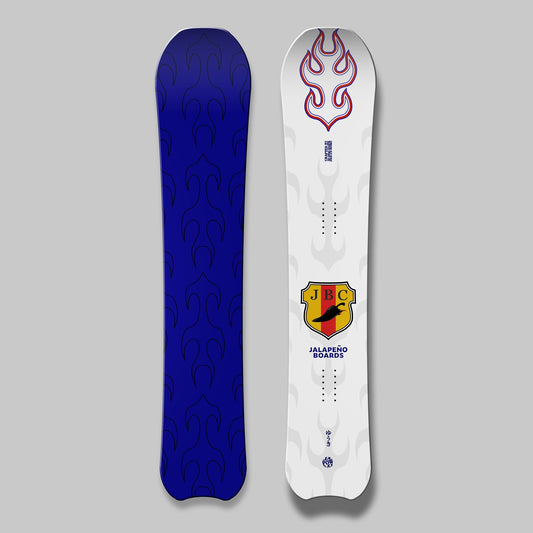
If the plan is a dedicated Hokkaido season -- the kind of trip built around maximising powder days rather than doing a general Japan tour -- a dedicated powder board makes a meaningful difference. The Japow98 ($599) was designed around exactly this kind of riding: a directional shape with a longer, rockered nose built for depth, and a flex profile that initiates turns in powder without the effort required on an all-mountain setup. Currently in stock in 151 and 156.
If you're renting gear in resort -- which is a legitimate option given the quality of Niseko's rental stock -- expect to pay $80 to $130 AUD per day for a complete snowboard setup. Weekly rates bring the per-day cost down. For a 7-day trip it can make financial sense to rent; for 14 days or more, bringing your own gear or buying locally usually wins.
Planning timeline for 2026/27
Niseko's demand has created a booking market where accommodation at the good properties in the good weeks fills 8 to 12 months before the season. The 2026/27 season runs from approximately December 2026 through March 2027. If you're reading this in mid-2026 and want a specific week -- particularly mid-January or the early December window -- the booking window is open now.
The sequence that works: lock in accommodation first (it's the hardest constraint), then book flights once the accommodation dates are set. Flight prices are more flexible and can often be found closer to departure; accommodation in Hirafu and Niseko Village during desirable weeks cannot.
Package deals through AU-based Japan ski specialists (there are several that operate exclusively for the Niseko market) can simplify the process and sometimes access accommodation that isn't available on standard booking platforms. Worth comparing against building your own package, especially for first-time visitors.
The case for going sooner than later
Hokkaido's snowpack has been reliable compared to many global ski destinations. The yen has remained relatively weak against the Australian dollar through 2025 and into 2026, which means the cost of in-resort spending -- accommodation, food, lift passes -- is more favourable for Australian visitors than it was five years ago. That equation will not last indefinitely.
The resort is also getting busier. Visitor volumes from China, Southeast Asia, and Australia have grown consistently through the decade. The quiet windows described above are quieter than peak, not quiet in an absolute sense. Each year the floor creeps up slightly.
If Niseko has been on the list, 2026/27 is a good year to stop keeping it there.