The Camber Profile That Actually Suits Australian Snow
Share
Ask any snowboard shop assistant which camber profile is more forgiving and they'll say rocker. That advice is correct for the terrain they're picturing: deep American powder where catching an edge means faceplanting into something soft. In Australia, where most resort days are groomed corduroy, firm hardpack, and variable afternoon slush, the conditions that make rocker forgiving rarely show up. The conditions that expose its weakness show up constantly. Rocker's main limitation is reduced edge hold on firm surfaces. In Australia, firm surfaces are the dominant terrain type.
This post explains how each camber profile actually performs on Australian resort snow, why the popular advice doesn't translate directly from Northern Hemisphere conditions, and what snowboard camber Australia riders should actually be looking for when they're buying for a local season.
What camber profile means and why it matters
Camber describes the shape of a board's base when it's sitting unweighted on a flat surface. It determines where and how the edges contact the snow, which changes how the board grips, turns, and floats. Three contact mechanics are worth understanding before anything else.
Edge contact points. A traditional camber board presses the base at multiple points along its full effective edge when weighted. A rocker board reduces that contact to two narrow zones near the tips. Less contact means less grip on firm snow.
Flex engagement. A cambered board loads energy underfoot and releases it through the turn. That's what gives it precision and pop. A rockered board releases freely in all directions, which can feel playful at low speed and vague at higher speed on firmer terrain.
Float in soft snow. Rocker tips the nose up naturally, helping the board ride over soft snow rather than diving into it. This is real and useful, but only when the snow is soft enough to sink into. On packed groomed runs, this advantage does not apply.
On Australian resort terrain -- wet, dense, variable, and predominantly firm -- the float advantage rarely applies and the edge contact difference matters on almost every run.
Traditional camber: what you get on AU hardpack
Traditional camber is an upward arc. When the board rests on a flat surface, the middle sits higher than the tips. When you weight it through a turn, the arc flattens, pressing the edge into the snow across its full contact length. Riders moving from rocker to traditional camber on hardpack usually describe the same sensation: the board feels locked in. It carves cleanly. It holds speed through the middle of the turn without washing out.
The reputation for being unforgiving comes from one specific situation: a beginner on soft groomed snow catching an edge because the board's natural tension is amplified by flat, consistent terrain. On firmer AU snow, catching an edge unintentionally is less common. The snow's surface texture resists unintended angle changes better than soft resort snow does. The "camber is unforgiving" framing has less relevance on Perisher's main groomed runs than it does on a beginner trail in Whistler in December.
Traditional camber's genuine limitation is at both extremes. Deep powder: the nose dives without rocker assist. Terrain park: less natural butter and press from the stiff underfoot profile. For all-mountain riding at Australian resorts, neither extreme is common enough to be a deciding factor.
Rocker: why the forgiving reputation exists and where it stops
Full rocker -- reverse camber, banana profile -- sits with tips higher than the middle when unweighted. Contact points are near the tip inserts rather than spread across the full edge. The board is loose and free-turning by design.
In deep powder this is excellent. The nose rides up without effort. Direction changes feel effortless. Edge catch in soft snow is nearly impossible. This is why rocker took over the market from roughly 2008 onwards and dominated the buying conversation for a decade.
On firm groomed snow, the same characteristics become liabilities. Riders who switch from camber to full rocker on hardpack describe the same thing: it feels skatey. Less grip, less precision, a vague feeling in the turn that gets worse as speed increases. This is not a matter of preference or adjustment time. It is a mechanical outcome of reduced edge contact length. Less contact on firm snow means less grip, less authority, and less confidence at speed.
For an Australian rider whose season includes a handful of genuine powder days and a majority of days on packed groomed terrain, a full rocker board is optimised for the minority of the riding. That is not a knock on rocker -- it makes it a specialist tool. If powder days are the priority and you have the flexibility to choose your days based on snowfall, the Japow98 ($599) is built for exactly that: a dedicated powder board that surfs deep snow in a way no all-mountain shape can match, with a directional shape and early rise that was specifically designed around riding deep. But for one board across a full Australian season, full rocker is optimised for the wrong days.
Flat: the honest middle ground
A flat-based board has no arc in either direction. Edge contact is better than rocker, not as good as traditional camber. Powder float is better than camber, not as good as rocker. It is genuinely the middle ground, not as a marketing compromise, but as a mechanical fact.
Flat boards ride well and suit a lot of recreational riders who are not pushing the limits in either direction. The limitation is that they can sit in an uncanny valley for riders who want more from one side or the other: not quite locked-in enough for riders who want to drive hard carves, not quite floating enough for dedicated powder days. For most riders buying their first or second board, flat is a safe choice that won't let them down. For riders who've developed a clear preference for how they like a board to feel underfoot, hybrid options tend to fit better.
Hybrid-rocker: the profile built for Australian conditions
Hybrid-rocker -- sometimes called rocker-camber-rocker or a camber-dominant hybrid -- combines traditional camber underfoot with rocker or early rise at the nose and tail. Between the bindings, the board behaves like a traditional cambered board: loads the edge, transfers energy through turns, holds on hardpack. At the tips, the early rise provides float assist in softer snow without the full contact-point reduction of a pure rocker profile.
For Australian resort conditions, this is a near-exact match.
- Icy morning groomers: camber underfoot loads the edge and holds through firm turns where rocker would skate.
- Chunky mid-morning hardpack: same edge authority, less wash-out at speed than a full rocker profile.
- Variable afternoon snow: tip rocker helps the nose stay on top of wet surface crud without diving or catching.
- The occasional powder day: the tip rise provides real float without giving up all-day hardpack performance.
This is why hybrid-rocker has become the dominant profile for all-mountain riding in Australian-sized seasons. It does not outperform a dedicated camber board on ice, or a dedicated rocker board in a metre of Hokkaido powder. It performs well across the full range of conditions an Australian rider actually encounters in a typical season, rather than being calibrated for a single condition type.
The 2026 season case for edge hold
The Bureau of Meteorology's outlook for winter 2026 is worth factoring into a board decision this year. An El Nino pattern is tracking as likely, which historically means below-average snowfall and above-average temperatures across the Snowy Mountains and Victorian Alps. That translates to more hardpack days, firmer icy mornings, and fewer of the bluebird powder days that justify a rocker-specific setup.
If the BOM outlook holds, 2026 will be a season where edge hold is rewarded consistently and powder float is tested rarely. That strengthens the case for camber underfoot -- whether traditional camber or hybrid-rocker -- beyond the usual argument. Riders planning to buy a board this season should weight the edge-hold side of the equation more than they might in a higher-snowfall year.
A straight decision guide for AU riders
Calibrated for Australian resort conditions, not Northern Hemisphere assumptions:
- You've been riding a few seasons and want to start carving properly: Traditional camber or hybrid-rocker. Either works on AU groomed runs. Hybrid-rocker gives you more margin on variable snow days.
- You're an intermediate rider on groomers most of the time: Hybrid-rocker. The camber underfoot gives you grip and turn energy; the tip rise keeps the nose out of trouble when conditions vary through the day.
- You are targeting powder days specifically and are comfortable riding less when conditions are firm: Full rocker or a dedicated powder board. Honest note: in an El Nino year, you'll ride it less than planned. The Japow98 is built for this role and does it better than any compromise shape, but go in with accurate expectations about AU powder frequency.
- You are a beginner: Hybrid-rocker or flat. The reduced underfoot tension compared to traditional camber is genuinely helpful while you're developing consistent edge angles. Hybrid-rocker keeps more options open as you progress.
Worth noting: how camber interacts with board shape -- twin, directional twin, full directional -- changes how each profile performs. A hybrid-rocker directional board rides differently to a hybrid-rocker twin in the same conditions. The twin vs directional breakdown covers the shape side of the decision, and reading both together gives you a clearer picture of what you're actually choosing between.
The Jalapeno95: hybrid-rocker calibrated for AU riding
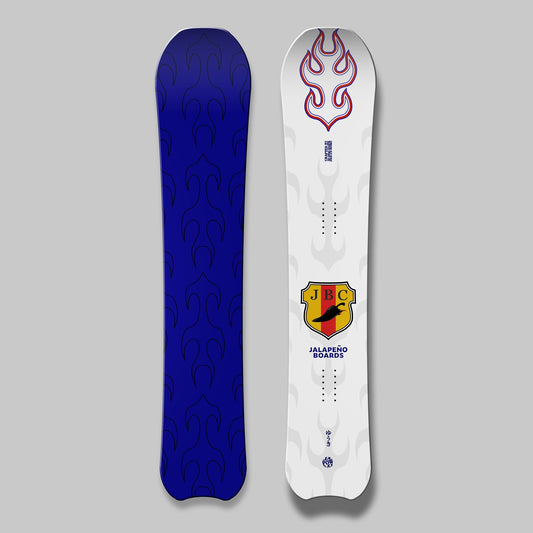
The Jalapeno95 ($849) runs a hybrid-rocker profile -- camber underfoot, rocker at the nose and tail. The flex is medium-stiff at 7 out of 10, which means it drives the camber through turns rather than letting it fold. The square-nose twin shape means it rides the same direction both ways, which matters across a season that moves between groomers, variable snow, and whatever else a day at Thredbo or Falls Creek throws up.
The board was designed specifically for Australian all-mountain riding, which means it was calibrated for the snow conditions you actually find at local resorts: predominantly firm, groomed, and variable through the day. The hybrid-rocker profile was chosen because it matches those conditions. Edge hold for the hardpack-heavy days that make up most of an Australian season, enough tip rise to handle variable afternoon snow without a dedicated powder setup.
Currently in stock in 153cm.
The short version
Rocker is more forgiving in deep powder. That is true and it is not what most Australian resort days look like. On predominantly firm, groomed terrain with variable afternoon conditions -- which is the actual description of a typical AU season -- camber underfoot is the better foundation for most riders. Hybrid-rocker delivers that edge authority without fully surrendering powder performance for the days when conditions cooperate. Pick the profile that matches your actual conditions, not the conditions assumed by the gear review written for a market where a metre of snow is a slow week.